E-mail: info@plymachine.com WhatsApp:+8619553901259

Views: 0 Author: Site Editor Publish Time: 2025-08-11 Origin: Site

Turning thick logs into thin, continuous sheets of wood veneer is a crucial step in plywood manufacturing. The key equipment responsible for this transformation is the veneer peeling machine. This article explores what a veneer peeling machine is, how it works, its main types, key components, and why it is indispensable in producing quality plywood efficiently.
With increasing demand for plywood in furniture, construction, and decoration industries, understanding the technology behind veneer production is essential for manufacturers. Selecting the right veneer peeling machine can significantly impact product quality, production efficiency, and overall cost-effectiveness.
A veneer peeling machine, often called a rotary lathe, is designed to peel logs into thin sheets called veneer. Unlike other woodworking methods, this process involves rotating a whole log against a stationary knife, peeling off a continuous, thin strip of wood. This method is highly efficient for producing uniform veneer sheets with minimal waste.
The term "veneer peeling" specifically refers to the rotary cutting method, where the log spins on its axis while a fixed knife moves linearly toward the log surface. The machine continuously removes a thin layer of wood, similar to unrolling a roll of paper. This continuous veneer sheet can then be used directly or further processed into plywood and other wood products.
To visualize, imagine a large cylindrical log clamped firmly between two points. As the log rotates steadily, a sharp, heavy-duty knife advances slowly into the log's surface, peeling a thin layer of wood. This differs from slicing or sawing veneer sheets individually. The rotary peeling method allows for high-speed operation and consistent thickness, which are essential in industrial plywood manufacturing.
The process is controlled carefully to maintain veneer thickness uniformity, which affects the final plywood's strength, appearance, and durability. Modern veneer peeling machines employ precise feed mechanisms and automated controls to optimize cutting parameters, reduce manual errors, and improve overall productivity.
Veneer peeling machines are primarily categorized into spindle (spindle-mounted) and spindleless types. Each type offers specific advantages depending on log size, wood species, and production goals.
Spindle veneer lathes clamp the log firmly between two centers on a rotating spindle shaft. This stable fixation allows for smooth and precise log rotation, making spindle machines especially suitable for larger diameter logs and the production of face veneers, where surface quality is paramount.
In this design, the spindle holds and spins the log at a controlled speed while the knife feeds steadily toward it, peeling off veneer in a continuous roll. The spindle ensures the log remains perfectly centered, minimizing vibration and uneven cuts.
Spindle peeling machines excel when processing uniform logs that demand higher veneer quality, as the stable rotation translates into better surface smoothness and consistent thickness. They are widely adopted in large plywood factories where the volume and quality standards are both high.
Spindleless veneer peeling machines replace the central spindle with a set of powered rollers that grip and rotate the log. This roller-guided approach is more flexible, especially for logs with irregular shapes, smaller diameters, or inconsistent dimensions.
By using rollers, the machine can adapt to logs that would otherwise be difficult or impossible to fix on a spindle lathe. This increases the range of logs that can be processed and reduces log preparation time.
Spindleless machines generally operate faster when handling smaller or lower-grade logs and are favored in environments where log supply is varied or lower in quality. However, surface finish and thickness control may not be as precise as spindle machines, making them more suited for core or back veneers rather than high-quality face veneers.
Some advanced veneer peeling lines incorporate hybrid technology, combining spindle and spindleless methods within the same production line. These systems allow manufacturers to switch between peeling methods based on log characteristics and production requirements, enhancing flexibility.
Hybrid lines enable factories to optimize veneer quality and yield by using the best peeling method for each batch of logs. Although such systems are less common due to their complexity and higher cost, they provide a competitive advantage where log variability is high.
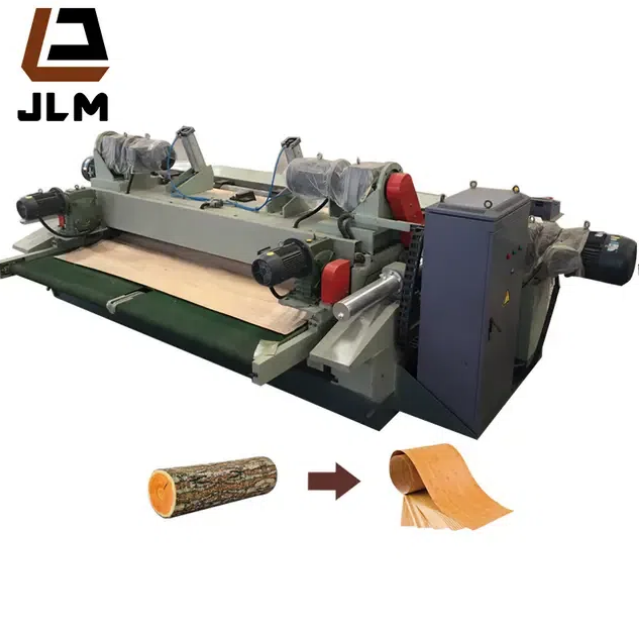
To better understand how veneer peeling machines operate and what to look for when purchasing, it is helpful to break down their key components:
Motor and Drive System: The heart of the machine, powering log rotation and the knife feed. High-quality motors ensure stable speed and torque to handle heavy logs with minimal vibration.
Knife Holder and Feed Mechanism: This assembly holds the cutting blade securely and moves it linearly toward the log surface. Precision in the feed rate is essential for maintaining consistent veneer thickness.
Log Clamping or Roller System: Depending on the machine type, this system either clamps the log between spindles or grips it with rollers to rotate it steadily during peeling.
Centering Unit: Ensures the log is properly aligned and balanced before peeling starts, reducing uneven wear and waste.
Clipping and Stacking Units: Automatically cut the continuous veneer sheets into required lengths and stack them neatly for further processing. Automation in this stage improves efficiency and reduces labor.
Control Panel: The operator interface that allows adjustment of parameters such as rotation speed, knife feed rate, and log positioning. Modern control panels often include touchscreen interfaces and programmable settings to improve user-friendliness.
Together, these components ensure the veneer peeling machine operates smoothly, reliably, and with precision, allowing manufacturers to maximize throughput while maintaining high product quality.
Rotary peeling remains the dominant method for producing veneer sheets used in plywood because of its multiple benefits:
High Yield and Minimal Waste: The rotary peeling process produces long continuous sheets with very thin layers peeled off, maximizing the usable wood from each log. This contrasts with slicing methods that produce more waste.
Consistent Thickness and Quality: Maintaining uniform veneer thickness is critical for plywood strength and surface finish. The precise control of peeling parameters in veneer peeling machines delivers high-quality veneer suitable for structural and decorative plywood.
Increased Production Speed: Automated rotary peeling lines operate at high speeds, enabling large-scale veneer output necessary to meet industrial plywood demands.
Versatility Across Wood Species: These machines can process a wide variety of wood species, including hardwoods and softwoods, adapting to different log sizes and characteristics.
Cost-Effectiveness: Though the initial investment in veneer peeling machinery can be significant, the increased yield, faster production, and reduced labor costs lead to lower overall production costs per unit of veneer.
For plywood manufacturers, investing in a reliable veneer peeling machine is a strategic decision that directly impacts production capacity, product quality, and profitability.
Shandong Jinlun Machinery Manufacture Limited Company, located in Linyi National Economic and Technological Development Zone, has specialized in developing and manufacturing veneer peeling machines since 2011. With over 12 years of focused experience and more than 60 national patents, Jinlun Machinery provides advanced, durable veneer peeling machines designed to meet diverse plywood production needs.
Their machines feature robust frames, high-speed motors, and precision knives engineered for clean, accurate peeling with minimal waste. Jinlun's veneer peeling machines support various wood species and log sizes, providing consistent, high-quality veneer output with stable performance.
In addition, the machines are equipped with user-friendly control panels and customizable settings to optimize production efficiency, making them suitable for both large-scale automated factories and smaller operations aiming to improve their veneer quality and output.
The veneer peeling machine is an indispensable piece of equipment in plywood manufacturing, offering a highly efficient way to convert logs into uniform veneer sheets. Whether you need to process large, high-quality logs with a spindle lathe or smaller, irregular logs with a spindleless machine, understanding the types and components of veneer peeling machines helps you choose the right solution.
Shandong Jinlun Machinery’s expertise and innovative designs ensure you receive reliable, high-performance veneer peeling machines tailored to your production requirements. To improve your plywood production process with state-of-the-art veneer peeling equipment, please contact us. Our team is ready to assist you in selecting the best machine for your business goals.


