E-mail: info@plymachine.com WhatsApp:+8619553901259

Views: 0 Author: Site Editor Publish Time: 2026-07-08 Origin: Site

The global shift toward plantation timber and fast-growing species changes everything. Small-diameter logs now dominate modern plywood manufacturing. Mill operators face a difficult daily challenge. Traditional spindle lathes struggle to process these smaller logs effectively. They leave behind large, unusable wood cores. This physical limitation severely reduces overall yield. It eats directly into your profit margins. You need a modern, reliable solution.
Introduce the spindleless veneer peeling machine. It acts as the ultimate bottom-of-funnel equipment. It maximizes wood recovery and maintains continuous production efficiency. This article provides procurement teams and mill managers a clear framework. You will learn how to evaluate, shortlist, and implement this technology. We cover core mechanics, operational benefits, and precise evaluation criteria. You can confidently upgrade your facility and optimize your resources.
Yield Optimization: Spindleless machines drive rotation via friction rollers, reducing the leftover log core to as little as 30-40mm, significantly increasing wood utilization.
Operational Fit: Designed specifically for small-diameter logs, these machines excel where traditional spindle lathes fail, making them essential for modern plantation timber processing.
Line Integration: Modern spindleless units integrate seamlessly into a continuous veneer peeling line, often combined with built-in clippers and stackers to reduce labor costs.
Procurement Logic: Choosing the right machine requires balancing motor capacity, roller configuration (e.g., 4-foot vs. 8-foot), and minimum core specifications against your specific raw material profile.
To understand the business case, look at the mechanical limitations of older equipment. Traditional spindle lathes rely on heavy mechanical chucks. These chucks grip the log firmly at both ends. They rotate the wood against a stationary cutting blade. However, this design creates a strict physical barrier. Once the log diameter shrinks close to the chuck size, peeling must stop. The blade would otherwise strike the metal chucks. This process typically leaves a leftover wood core measuring 80mm to 100mm in diameter.
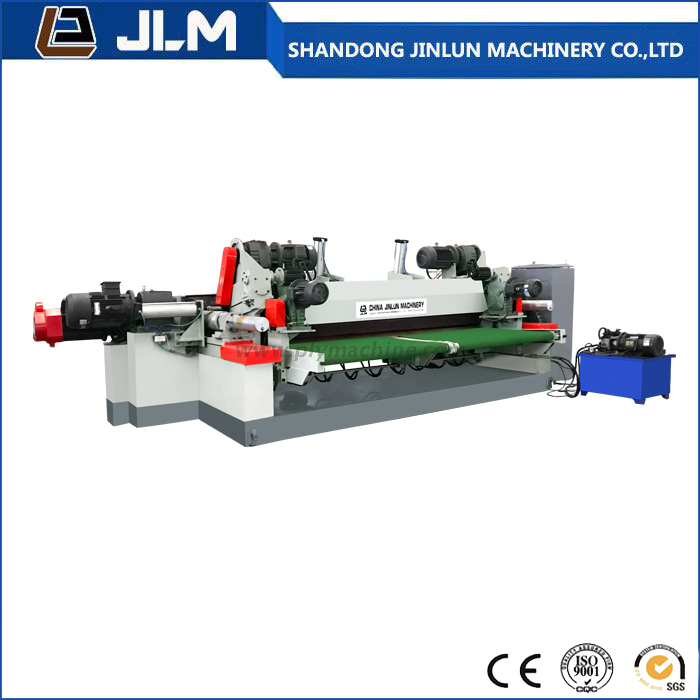
Friction-driven technology removes this barrier. Removing the spindle eliminates the metal chucks entirely. Powered friction rollers press directly against the log surface. They spin the wood evenly. This allows the machine to peel logs down to a minimal core diameter. You can often reduce the final core to just 35mm.
Consider the exact cost of waste. Reducing the final core size by even one inch matters. Imagine your facility processes 2,000 logs daily. Recovering an extra 40mm of wood from every single log translates to massive volume gains. You capture high-grade wood previously sold as low-value scrap. This directly improves your profit margins. You gain higher material efficiency across the entire plant.
Feature Focus | Traditional Spindle Lathe | Spindleless Lathe |
|---|---|---|
Core Rotation Method | Mechanical end-chucks | Powered friction rollers |
Minimum Core Size | 80mm – 100mm | 30mm – 40mm |
Log Loading Speed | Slower (requires manual chuck alignment) | Faster (automated cradle drop-in) |
Ideal Log Profile | Large diameter, old-growth timber | Small diameter, plantation timber |
How does this equipment actually function? The process relies on a straightforward friction-drive operation. Powered rollers press against the log. They rotate the wood against a fixed or dynamically adjusting knife.
Here are the primary stages of operation:
Log Feeding: Automated conveyors drop the debarked log into the roller cradle smoothly.
Friction Engagement: Chrome-plated rollers clamp down. They apply immense pressure to spin the wood steadily.
Continuous Peeling: The wood spins against the precision blade. The machine peels a continuous ribbon of uniform veneer.
Modern CNC (Computer Numerical Control) systems manage thickness control perfectly. Servo motors adjust the blade angle and gap instantly. They maintain consistent veneer thickness throughout the run. The log diameter decreases rapidly, but the output remains uniform. A reliable veneer peeling machine prevents uneven sheets. It guarantees high-quality structural results.
Many units also feature built-in tenderizing mechanisms. These systems score the veneer surface slightly during the cut. Tenderizing improves the flexibility of the peeled wood. It also enhances drying characteristics later in the production process. You actively prevent splitting and warping.
Maximized wood recovery remains the definitive metric for success. You must convert low-value, small-diameter logs into high-value commercial veneer. Spindleless technology achieves this goal efficiently. It extracts every possible millimeter of usable material. Yield increases drive immediate return on investment.
Continuous production speed serves as another major benefit. Old machines required constant stopping. Operators spent valuable time chucking and unchucking logs manually. Spindleless designs eliminate this downtime completely. The equipment drops a new log into the cradle instantly. This continuous flow increases the throughput rate of your entire veneer peeling line.
You will also notice reduced labor dependency. Automation capabilities reduce manual handling drastically. Automated log feeding systems move materials seamlessly across the floor. Integrated rotary clippers cut the veneer to size automatically. You reduce operator fatigue and minimize expensive human error.
Finally, consider the operational footprint. Spindleless units often require less heavy foundational infrastructure. Large-scale spindle lathes need massive concrete bases to absorb operational vibration. Spindleless models operate smoothly in tighter spaces. They offer mill managers superior layout flexibility.
Performance Metric | Industry Standard (Spindle) | Optimized Output (Spindleless) |
|---|---|---|
Wood Recovery Rate | 50% - 60% | 85% - 90% |
Logs Processed Per Hour | Moderate | High (Continuous Flow) |
Labor Required Per Shift | 3-4 Operators | 1-2 Operators |
Core veneer production serves as the primary application worldwide. The industry standard demands spindleless peeled veneer today. Manufacturers use it extensively for the inner plies of commercial plywood. It also forms the structural backbone of LVL (Laminated Veneer Lumber) and blockboard panels. The uniform thickness ensures structural integrity in the final finished panel.
Species adaptability gives you incredible production flexibility. Evaluate machine performance across various fast-growing timber species. These machines handle Poplar, Eucalyptus, Radiata Pine, and Rubberwood effortlessly. Different woods require different blade angles and cutting pressures. Modern machines adjust parameters quickly to match the specific wood density.
Format flexibility ensures you meet diverse market demands. Equipment variations exist for specific product outputs. Mills use standard 4-foot machines for core veneer processing. Alternatively, 8-foot machines excel at face and back veneer applications. Buyers must map the equipment size directly to their target product dimensions.
Choosing the right equipment requires careful analysis. Use the following criteria to guide your procurement process confidently.
Minimum Core Diameter: This represents the ultimate performance metric. Advise your buyers to verify the exact minimum peeling diameter. Look for a 35mm capability rather than a standard 45mm model. A tighter roller design yields significantly more wood.
Roller Specifications and Motor Power: Hardened, chrome-plated rollers prevent log slippage effectively. Adequate servo motor torque ensures uniform sheet thickness. Weak motors stall during hardwood processing. Always specify high-torque components.
Feed System and Knife Gap Adjustment: Automated knife gap adjustment remains absolutely necessary. CNC-controlled systems handle varying wood densities flawlessly. They ensure safe, compliant operation. Manual adjustments cause unwanted downtime and inconsistent quality.
Integration Readiness: Evaluate your current mill workflow carefully. Provide a checklist for your engineering team. The new equipment must sync seamlessly. Check compatibility across log debarkers, conveyors, and automated rotary clippers.
After-Sales and Parts Availability: Localized maintenance support matters heavily. Friction rollers act as high-wear consumables. Blades require regular replacement and sharpening. Prioritize vendors offering rapid parts delivery and local technical support.
What to watch out for: Do not buy cheap equipment lacking accessible spare parts. Prolonged downtime ruins profitability quickly. Ensure the manufacturer provides clear maintenance schedules and robust warranty terms.
For small-diameter plantation logs, spindleless peeling is not an optional upgrade. It represents a baseline requirement for competitive yield. You cannot maximize profits using outdated spindle chucks. This technology redefines resource efficiency and throughput.
Decision-makers should immediately audit their current average log diameter. Calculate your potential yield increases accurately. Compare your current waste core size to a 35mm optimization target. The mathematical difference justifies the financial investment quickly.
Review technical specification sheets from trusted equipment manufacturers. Request an ROI calculation based on your specific local wood species. Consult an integration engineer to plan your facility upgrade today. Take action now to secure your market position and boost your operational margins.
A: Typically can peel logs down to a 30mm–45mm core, depending on the machine's specific roller configuration and the wood's density.
A: Yes, but it requires higher motor torque, reinforced rollers, and potentially pre-conditioning (boiling/steaming) the logs to prevent splitting and reduce machine wear.
A: It usually sits downstream from a log debarker (often a spindleless debarker) and feeds directly into an auto-clipper and stacker, forming a continuous, automated workflow.
A: While mechanically simpler without complex hydraulic chucks, spindleless machines require strict maintenance of the friction rollers and frequent blade calibration to prevent log slippage.