E-mail: info@plymachine.com WhatsApp:+8619553901259

Views: 0 Author: Site Editor Publish Time: 2026-03-16 Origin: Site

Setting up a veneer peeling line is a precise sequence of operations: log preparation, peeling, veneer analysis, clipping, and stacking. Each step requires careful specification and verification to ensure efficient production and high-quality veneer output.
For production engineers and plant planners, understanding the proper layout, workflow, and quality control points is essential for a successful installation or retrofit of a peeling line.
A well-designed veneer peeling line typically follows a linear workflow to optimize space and streamline production. Logs enter at one end and finished veneer stacks exit at the other, minimizing material handling and reducing cross-traffic.
The recommended setup includes:
Log Receiving Area: Located near the raw material unloading zone, with enough space for size sorting and storage. Efficient log sorting at this stage can drastically improve peeling line efficiency, as logs are grouped according to species, diameter, and moisture content for optimal processing.
Debarking Station: Positioned adjacent to receiving to remove bark efficiently before peeling. Modern debarkers use rotating drums, flails, or hydraulic rollers to strip bark while minimizing damage to the log surface, preventing premature knife wear and ensuring veneer quality.
Centering and Block Preparation Station: Logs are cut to length and precisely centered to maximize veneer yield. Centering accuracy is a cornerstone of quality veneer production, directly affecting knife wear, veneer thickness uniformity, and overall yield.
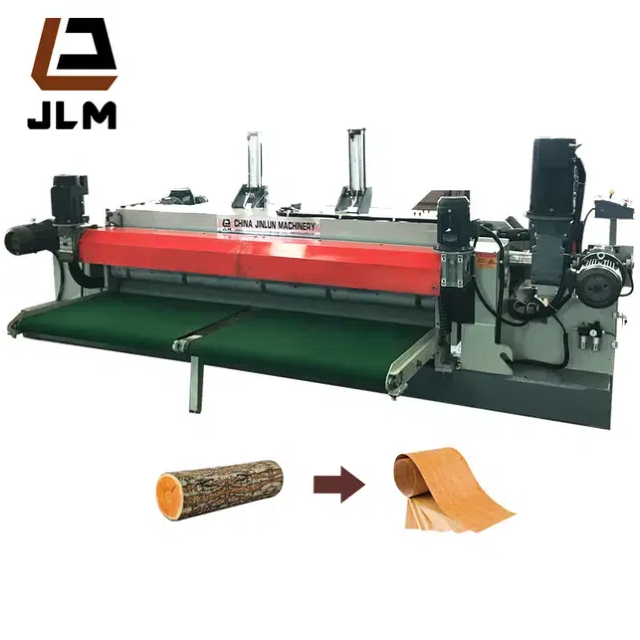
Peeling Station: The core part of the line, equipped with spindle or spindleless peeling machines, depending on log characteristics and product goals. Its position must allow smooth material flow and sufficient operator access.
Veneer Analysis and Clipping Area: Inline sensors continuously monitor veneer thickness and surface defects, ensuring only quality veneers proceed downstream. Automated clippers cut veneers to precise lengths, optimizing panel production compatibility.
Stacking Area: Veneers are carefully layered to prevent curling and prepare for drying or pressing. The stacking area should be ergonomically designed for efficient handling and integration with downstream drying systems.
Power and Utilities: Adequate electrical supply with safety interlocks, compressed air for pneumatic controls, and dust extraction systems are critical for safe and efficient operation. Utility planning should consider future line expansions.
Space allocation should also account for maintenance aisles, emergency exits, and operator facilities. Adequate lighting and ventilation further contribute to safety and productivity.
Each phase of the veneer peeling line focuses on a single critical task to ensure quality and minimize errors.
Upon arrival, logs should be immediately sorted based on diameter, species, straightness, and moisture content. This categorization ensures that logs are processed with appropriate peeling machine settings and reduces downtime from unsuitable raw materials.
Effective debarking removes bark and dirt, which can dull knives and contaminate veneer surfaces. Care must be taken to avoid excessive damage to the log’s outer wood layer during debarking, as this impacts veneer smoothness and increases waste.
Routine inspection of debarking equipment and scheduled maintenance prevent bottlenecks in this crucial upstream step.
Logs are cut to length blocks suitable for your peeling machine and product specifications. Precise centering of these blocks is essential — misalignment leads to uneven veneer thickness, reduced yield, and increased knife wear.
Centering systems may include mechanical guides, laser or camera-based sensors, and automated actuators to align logs dynamically. Operators should be trained to monitor centering accuracy and intervene if irregularities arise.
Consistent block length contributes to veneer length uniformity, simplifying subsequent clipping and stacking operations.
At the peeling station, the log rotates against a stationary knife to produce continuous veneer sheets. Correct knife setup includes adjusting knife angle, sharpness, and gap to accommodate log species, diameter, and moisture content.
Spindle machines require logs to be securely clamped between centers, whereas spindleless machines use rollers for log rotation. Operators must be trained to recognize and adjust peeling parameters to minimize defects like veneer tears, splits, or uneven thickness.
Regular knife inspection and replacement schedules improve line reliability and veneer quality.
Inline sensors are increasingly sophisticated, employing laser triangulation, ultrasonic thickness measurement, or optical scanning to detect veneer defects or thickness variations in real-time.
This data feeds into control systems that can adjust peeling parameters dynamically or flag defective sheets for removal. Automated clippers then cut veneers to specified lengths, reducing manual labor and ensuring consistent panel dimensions.
Routine calibration of sensors and clipping equipment ensures accuracy and prevents material loss.
Correct stacking preserves veneer flatness and prepares sheets for downstream drying or pressing. Stackers must layer veneers with proper grain alignment and uniform pressure.
Incorrect stacking can lead to curling, warping, or adhesive bonding problems later in plywood manufacturing.
Using automated stack handling equipment such as stack turners and conveyors reduces manual handling, speeds up line throughput, and minimizes sheet damage.
Operators should monitor stacks regularly for signs of deformation and intervene as necessary.
Electrical systems must meet all regulatory standards, incorporating emergency stops, safety interlocks, and fail-safe wiring.
Thorough testing of safety circuits, emergency stops, and interlocks is mandatory before production begins. Pneumatic and hydraulic systems should also be pressure tested and leak-checked.
Comprehensive operator safety training covering emergency procedures and lockout-tagout protocols is essential to prevent accidents.
Prior to full production, execute a commissioning protocol that includes:
Multiple test peel runs using representative logs.
Measurement and verification of veneer thickness consistency.
Comparison of actual yield against vendor specifications.
Comprehensive safety inspections and functional testing of emergency systems.
Operator training sessions covering setup, operation, and maintenance.
Documentation of all tests and formal sign-off by project stakeholders.
This rigorous process confirms the line’s readiness and reduces future downtime.
Poor Centering: Causes uneven veneer thickness and higher waste. Regular calibration and use of precision centering systems reduce this risk.
Incorrect Knife Gap: Too wide leads to veneer tears; too narrow can cause machine stalls or knife damage. Maintain knife sharpness and adjust gaps frequently.
Inadequate Stacking: Results in veneer curl and deformation, complicating drying and pressing. Train staff on stacking methods and employ appropriate handling equipment.
Sensor Calibration Drift: Leads to inaccurate defect detection or thickness measurement. Schedule regular sensor checks and recalibration.
Proactive maintenance and operator vigilance are key to minimizing these issues.
Setting up a veneer peeling line demands careful planning and execution, starting from raw material receiving through to veneer stacking. Each stage requires precise control, quality checks, and safety considerations to ensure efficient, high-quality veneer production.
Following the step-by-step guide and commissioning checklist provided will help production engineers and plant planners achieve a smooth installation or retrofit process with minimized downtime.
For customized solutions, equipment recommendations, or expert technical support on setting up your veneer peeling line, please contact us. Shandong Jinlun Machinery brings over a decade of industry expertise and patented technologies to support your plywood manufacturing success.


