E-mail: info@plymachine.com WhatsApp:+8619553901259

Views: 0 Author: Site Editor Publish Time: 2025-08-14 Origin: Site


Choosing the right veneer peeling machine means matching your logs, product specifications, and output targets. This step-by-step guide provides a practical checklist to help factory managers and procurement professionals make informed decisions, ensuring you select the optimal machine for your plywood production needs.
Selecting a veneer peeling machine is a critical investment impacting product quality, efficiency, and profitability. By understanding key factors from raw materials to after-sales service, you can build a clear decision-making process that suits your unique production goals.
Before exploring machine features or brands, it is essential to clearly define your target veneer product specifications. These requirements will directly influence the type of veneer peeling machine best suited for your production line.
Your desired veneer thickness and quality determine whether you should select a spindle lathe, spindleless machine, or even a slicer. For producing high-quality face veneers, where smoothness and uniformity are crucial, spindle machines are usually preferred because of their precise log centering and stable rotation. On the other hand, spindleless machines are better suited for core veneers or lower-grade products where speed and flexibility with irregular logs are more important than perfect surface finish. Specialty veneers with very thin or decorative profiles might require slicing machines, though these differ from peeling machines and serve different production needs.
Also, consider your panel sizes and downstream processes. The dimensions of your final plywood panels set the required veneer width and length. Make sure the peeling machine you choose can produce veneer sheets that match these requirements, preventing costly adjustments later in drying, clipping, or gluing stages. For example, the maximum peeling width should accommodate your widest panel size, while veneer length capabilities should align with your line’s handling and stacking systems.
Raw material characteristics are critical in selecting the right machine since different machines handle log sizes and qualities differently.
For log diameter, smaller logs ranging from approximately 10 to 30 centimeters are generally best handled by spindleless, roller-guided peeling machines. Medium-sized logs, typically between 30 and 90 centimeters in diameter, are ideal for spindle-mounted lathes, which provide more precise control and better veneer quality. Very large logs over 90 centimeters in diameter usually require custom or heavy-duty spindle peeling machines, designed to manage the increased size and weight.
Beyond diameter, the straightness of the logs matters significantly. Logs with substantial curvature or deformities can lead to uneven veneer thickness unless the machine is equipped with advanced centering and stabilization systems to compensate for irregularities.
Wood species and moisture content are also important considerations. Hardwoods often require more powerful motors and sharper knives due to their density, while the moisture content influences veneer smoothness and yield. Choose a machine designed to handle the specific wood types and moisture levels you expect in your production to ensure consistent results.
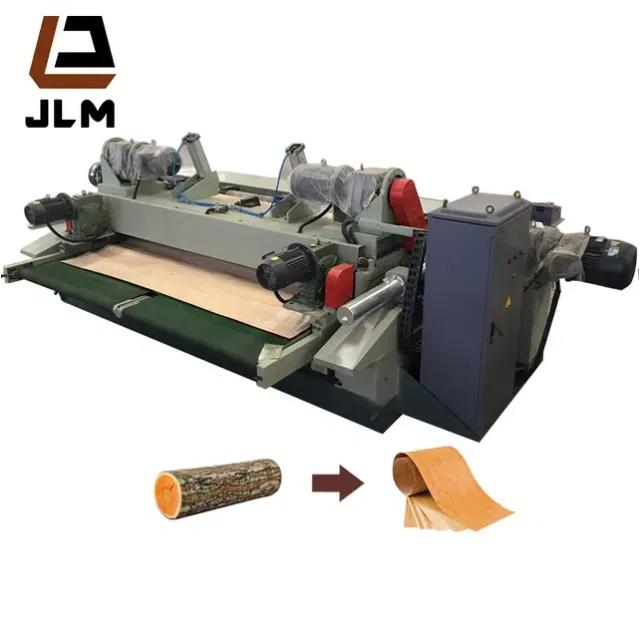
Clearly define your desired production volume in square meters per day, as this will guide your choice of machine capacity and operating speed. Consider whether your production will run continuously or in batches, as this affects the durability requirements and maintenance scheduling of the machine.
Maximizing veneer yield is critical to reducing raw material waste and improving profitability. Machines featuring high-precision log centering and knife feed control typically deliver more consistent veneer thickness, resulting in less reject material. When evaluating vendors, ask for yield reports or acceptance test results that demonstrate real-world performance under typical operating conditions. Including these reports in your Request for Proposal (RFP) will help ensure that the machine meets your efficiency expectations.
Modern veneer peeling machines incorporate technologies that improve precision, efficiency, and enable data-driven decisions.
CNC (Computer Numerical Control) knife systems allow precise control over blade positioning and feed rate, ensuring uniform veneer thickness. Automated knife change systems reduce downtime by enabling fast and safe blade swaps without stopping the production line.
Automated log centering and stabilization systems use sensors and actuators to position the log optimally during peeling, minimizing vibration and improving veneer uniformity. This is especially beneficial when processing logs with irregular shapes.
Advanced sensors can analyze veneer quality in real-time, detecting defects or thickness variations. Coupled with data collection and analytics software, these features help manufacturers optimize production, identify maintenance needs early, and improve overall yield.
A veneer peeling machine represents a long-term investment, so after-sales support and spare parts availability are essential factors.
Make sure to clarify the vendor’s service level agreements (SLAs), particularly their response times for technical support and repairs. Fast response reduces costly production downtime.
Check spare parts lead times carefully. Long delays in obtaining critical components can disrupt your operations. Ideally, the supplier should maintain a local inventory or offer expedited shipping.
Professional on-site commissioning ensures the machine is installed correctly and tailored to your specific production environment. Comprehensive training plans for operators and maintenance staff guarantee safe operation and help maximize machine lifespan.
Prepare a list of vendor support questions for your RFP, such as average response times, warranty terms, and availability of technical manuals.
Look beyond the initial capital expenditure (CAPEX) by evaluating operational costs and return on investment.
Energy-efficient motors and automated lubrication systems lower electricity use and maintenance time, reducing overall operating costs. Similarly, machines requiring fewer maintenance hours improve uptime and reduce labor expenses.
Although advanced machines might have higher upfront costs, improved yield and product quality often justify the investment. Calculate your expected ROI by considering increased throughput, reduced material waste, and savings in maintenance and energy.
Lastly, inquire about financing options such as leasing or installment plans, which can ease capital investment pressures.
Choosing the suitable veneer peeling machine requires a thorough understanding of your product specifications, raw material characteristics, and production goals. Start by defining your target veneer thickness, quality, and panel sizes to determine the most suitable peeling technology. Carefully assess your logs’ diameter, straightness, species, and moisture levels to match the machine’s handling capabilities. Set clear capacity and yield targets and request vendor performance data to verify their claims.
Prioritize machines with advanced CNC controls, automated knife changes, and precise log centering for better efficiency and veneer quality. Equally important are dependable after-sales service, spare parts availability, and operator training to ensure smooth, long-term operation. Finally, evaluate total cost of ownership and potential return on investment, while considering financing solutions that suit your budget.
Shandong Jinlun Machinery offers a comprehensive range of veneer peeling machines backed by years of expertise and innovation. Our products combine cutting-edge technology, robust performance, and dedicated local support to help you achieve your plywood production goals. To explore options tailored to your specific needs, please contact us. Our knowledgeable team is ready to assist you in selecting the ideal veneer peeling machine.


