E-mail: info@plymachine.com WhatsApp:+8619553901259

Views: 0 Author: Site Editor Publish Time: 2026-03-23 Origin: Site

The best rotary peeling machine for plywood factory varies depending on your log types, production goals, and budget. This article breaks down the top machine types and key features to consider for different factory profiles, helping you quickly identify suitable options for your plywood production line.
Understanding which rotary veneer peeling machine fits your operation ensures optimal yield, veneer quality, and return on investment.
Rotary peeling is a wood processing method where an entire log rotates against a stationary cutting knife, peeling off a continuous thin sheet of wood veneer. This technique contrasts with slicing, which cuts veneer sheets from a block or flitch using a knife moving in a linear or oscillating motion.
Rotary peeling has become the dominant method for plywood veneer production worldwide because it offers several key advantages. It enables high-speed, continuous production of wide, long veneer sheets with minimal wood waste. The process’s efficiency translates into higher output and better resource utilization compared to slicing or sawing methods, which tend to be slower and produce more offcuts.
Another reason rotary peeling is preferred in plywood manufacturing is the uniformity of veneer thickness it delivers. Consistent veneer sheets are critical to plywood strength, stability, and appearance. Rotary veneer sheets also adapt well to further processing such as drying, gluing, and pressing, making them ideal for mass plywood production.
While slicing remains popular for decorative or specialty veneers that require unique surface finishes or patterns, rotary peeling machines are the backbone of industrial plywood factories. Their ability to handle diverse log sizes and species with high throughput makes them essential equipment.
Choosing the right rotary peeling machine requires evaluating multiple factors related to your raw materials, desired product quality, capital investment capacity, and production automation goals.
Log Diameter and Consistency: Log size plays a significant role in determining which peeling technology suits your needs. Small diameter or irregular logs favor machines with flexible gripping mechanisms, while large, uniform logs require robust holding systems to maintain precision.
Veneer Quality: The level of surface finish and thickness uniformity you require influences the choice between spindle, spindleless, or hybrid peeling machines. Premium face veneers demand precise control and stable rotation, while core or lower-grade veneers allow for faster, more flexible peeling.
CAPEX vs. OEE (Overall Equipment Effectiveness): Your budget constraints and expectations for machine uptime and efficiency will affect the level of technology and automation you can justify. Higher automation typically increases CAPEX but improves OEE through reduced downtime and labor costs.
Automation Level: From manual or semi-automatic lines to fully CNC-controlled peeling machines, your desired degree of automation impacts throughput, quality consistency, and operator workload.
Small factories, often working with smaller or more variable logs, limited budgets, and lower production volumes, typically benefit from spindleless peeling machines. Their roller-based log gripping offers flexibility, and faster cycle times help maximize throughput despite variable raw materials.
Medium-sized factories aiming to balance quality and yield generally favor spindle lathe peeling machines. These machines provide better veneer surface quality, making them suitable for mid-range to high-end plywood products while maintaining respectable throughput rates.
Large, industrial plywood factories with consistent log supplies and ambitious production targets often invest in hybrid or CNC rotary peeling machines. These advanced lines offer the best of both worlds — combining high yield and premium veneer quality through sophisticated automation, precise knife control, and adaptable log handling.
This matrix approach assists buyers in narrowing down machine choices that best align with their operational realities and business goals.
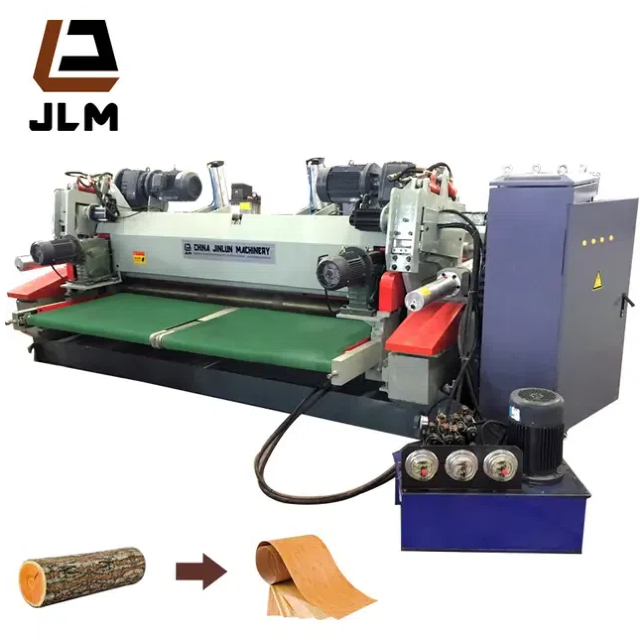
Spindle lathe peeling machines clamp logs firmly between centers on a spindle shaft. This firm fixation reduces log vibration, enabling smooth and precise rotation. Such stability is crucial when producing high-quality face veneers, where surface smoothness and thickness uniformity directly affect plywood appearance and structural integrity.
Spindle lathes also accommodate a wide range of log diameters, especially medium to large sizes, and work effectively with dense hardwoods. Their reliability and precision have made them a staple in mid to large plywood manufacturing facilities focused on premium products.
Additionally, spindle lathes offer relatively straightforward maintenance and operator training, making them accessible to factories with moderate automation levels.
Spindleless machines replace the central spindle with powered rollers that grip and rotate the log. This design increases flexibility for peeling smaller, irregular, or lower-quality logs that are difficult to mount on traditional spindles.
The roller-guided mechanism allows for faster log loading and peeling cycles, enhancing throughput. While spindleless machines generally produce veneers with slightly less surface finish precision than spindle lathes, they are well suited for core veneers or applications where high volume outweighs appearance.
Small to medium factories dealing with a wide variety of logs often choose spindleless machines for their adaptability and cost-effectiveness.
Hybrid rotary peeling machines integrate both spindle and spindleless technologies in a single production line. This allows factories to switch between peeling modes depending on the log batch or desired veneer quality, optimizing both yield and surface finish.
CNC rotary peeling machines elevate veneer production by incorporating computer numerical control for knife positioning, feed rates, and log handling. This precision minimizes veneer thickness variation, reduces waste, and improves quality consistency.
High automation levels in CNC lines lower labor requirements and enable real-time monitoring and data collection for process optimization. These features make hybrid and CNC rotary peeling machines ideal for large industrial plywood factories producing high-value veneers.
When evaluating rotary veneer peeling machines, consider the following critical features during demos or vendor assessments:
Veneer Thickness Tolerance: The machine must reliably produce veneers within your specified thickness range. Tight tolerance improves plywood strength and surface quality.
Knife Automation: Automatic knife changes, sharpening, and precise feed control reduce downtime and improve consistency, increasing overall line efficiency.
Block Centering Accuracy: Advanced centering systems stabilize the log during peeling, reducing defects and increasing yield. This is particularly important when processing irregular logs.
Peeling Speed and Throughput: The operational speed must align with your daily production targets without compromising veneer quality or machine longevity.
Downtime Handling: Features such as quick stop/restart modes, emergency shutdown, and easy access for maintenance minimize production losses and improve safety.
Energy Efficiency: Energy-saving motors and systems help reduce operating costs and environmental impact.
Spare Parts Access and Service Support: Ensure the vendor provides local spare parts inventories and responsive technical support to minimize machine downtime.
Selecting the best rotary peeling machine for plywood factory requires a clear understanding of your raw materials, production goals, and financial constraints. Begin by identifying your factory profile and priorities — whether you need flexibility for smaller logs, superior veneer quality, or a balance of both with advanced automation.
Use the selection matrix to guide your choice between spindle, spindleless, and hybrid CNC peeling machines. Carefully assess critical machine features such as veneer thickness tolerance, knife automation, block centering accuracy, and energy consumption. Vendor support, spare parts availability, and after-sales service should also weigh heavily in your decision.
After narrowing your options, shortlist two to three suppliers and arrange on-site test peel demonstrations to evaluate machine performance in real-world conditions. This hands-on evaluation helps confirm that the machine meets your throughput and quality requirements before making a significant investment.
Shandong Jinlun Machinery offers a versatile range of rotary veneer peeling machines engineered for different factory scales and production needs. With over a decade of experience, patented technologies, and a commitment to customer support, Jinlun Machinery ensures your plywood factory achieves maximum efficiency, product quality, and profitability. For personalized guidance or to schedule a demonstration, please contact us. Our expert team is ready to help you find the perfect rotary peeling machine for your business.


